


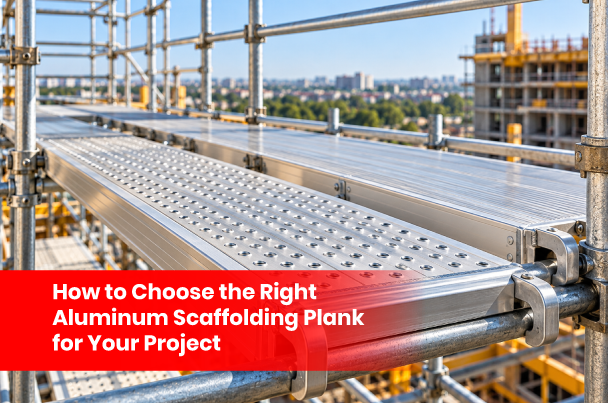
Picking a scaffold platform is a bigger part of planning construction, maintenance and renovation work than it might seem. Get the plank wrong and you could be dealing with compatibility problems, a delayed install, or a platform that simply doesn’t give your crew the working space it needs.
So what should you check? When choosing an aluminum scaffolding plank, look at its length, width, rated load capacity, scaffold compatibility, locking mechanism and intended application. It’s also worth deciding early whether the job calls for a standard walk board, an extendable plank or a platform with ladder access.
Aluminum planks have a lot going for them. They’re relatively lightweight, they resist rust and they’re easy to move from one jobsite to the next. Still, not every plank suits every scaffolding system, or every project.
What Are Aluminum Scaffolding Planks?
Aluminum scaffolding planks are manufactured platforms that give you a working surface on compatible scaffolding structures. Some have an all-aluminum deck. Others pair aluminum framing with a plywood walking surface. It comes down to the design.
Features you will commonly see include:
- A slip-resistant walking surface
- Hooks made for compatible scaffold supports
- Wind latches or other locking mechanisms
- Structural reinforcement underneath the platform
- A range of lengths and widths to suit different scaffold configurations
Want to compare product dimensions and intended applications? Contractors can review available aluminum scaffolding planks before buying.
1. Choose the Correct Aluminum Scaffold Plank Length
How long does the plank need to be? That depends on the distance between approved support points and the hook or bearing arrangement the manufacturer specifies. Shorter walk boards can work for compact sections. Longer ones may cover wider working areas.
Here’s an example. Scaffolds Supply offers a 7-foot aluminum scaffold plank with a 19-inch-wide deck, replaceable hooks and wind latches for compatible supports.
Before you order:
- Measure the distance between scaffold supports.
- Confirm the support spacing that’s permitted.
- Check the actual dimensions and how the hooks fit.
- Verify how much platform coverage you need.
And never assume a plank will work just because its listed length matches the scaffold bay.
2. Check the Scaffold Plank Load Capacity
Every plank has to carry its intended working load. That means the workers, plus their tools, equipment and materials. Ratings can vary with length and construction type. One 7-foot all-aluminum model, for instance, is listed at 75 pounds per square foot, while a 10-foot model is listed at 50 pounds per square foot. Those are published ratings for those specific products. They aren’t universal values.
Check the manufacturer’s published rating for the exact plank and support arrangement you’ll be using. Concentrated loads may behave differently from distributed ones. And the scaffold structure underneath needs adequate capacity too.
3. Match the Plank to Your Aluminium Scaffold System
An aluminium scaffold could be a mobile tower, a frame scaffold or another approved arrangement, and each system can come with its own platform connection requirements. Check:
- The scaffold model and manufacturer
- Support tube dimensions and spacing
- Hook type and locking devices
- The permitted span and bearing arrangement
- Platform width and how it fits with adjacent boards
Want some background on different plank materials first? Read the existing complete guide to scaffold planks before you start comparing specific products.
Never modify hooks or supports to force an incompatible plank to fit.
4. When Should You Choose a Ladder Scaffold Plank?
When people say ladder scaffold plank, they usually mean a hatch deck that comes with an integrated or compatible ladder. It lets workers move between approved scaffold levels, and the access opening can be closed off.
What it typically gives you:
- A designated access point between levels
- A hatch you can close when it’s not in use
- An integrated or compatible ladder
- A working platform around the hatch opening
Take the 7-foot hatch deck scaffold plank as an example. It has a 28-inch-wide aluminum-framed plywood deck, a hatch and a drop-down ladder.
Just make sure the access configuration is approved for your scaffold and meets the applicable requirements.
5. Are Aluminum Extendable Planks Suitable for Your Project?
Aluminum extendable planks let you adjust the platform length, within the limits the manufacturer sets. Be careful here, though. Some are designed for ladder staging instead of conventional scaffold frames, so the product category on its own doesn’t tell you whether a plank is suitable.
- Check the minimum and maximum length.
- Verify the load rating at every permitted extension.
- Confirm the approved support and system compatibility.
- Check the locks and the required overlap of the sliding section.
- Follow the manufacturer’s installation instructions.
A ladder-rated extendable plank should not go on scaffolding unless the manufacturer has specifically approved that use.
6. Can Aluminum Planks Be Used for Bleachers?
Aluminum planks for bleachers are used in spectator seating and walkway structures. Don’t treat them as automatic stand-ins for scaffold walk boards. The connections, load cases and safety requirements are different.
| Feature | Scaffold planks | Bleacher planks |
| Typical use | Construction work platforms | Seating or pedestrian walkways |
| Connections | Approved scaffold hooks or retainers | Bleacher-specific brackets or fasteners |
| Loads | Scaffold working loads | Occupancy and seating design loads |
| Interchangeability | Only with approval | Only with approval |
For bleachers, choose products manufactured and rated for the actual bleacher system. Matching dimensions alone don’t prove compatibility.
7. Compare All-Aluminum and Aluminum-Plywood Planks
Here’s how the two main types stack up.
| Factor | All-aluminum | Aluminum-plywood |
| Deck | Aluminum | Plywood over aluminum frame |
| Moisture concerns | Inspect aluminum and connections | Also inspect plywood and its fixings |
| Surface | Manufactured grip pattern | Often coated or textured |
| Priority | Capacity, fit and damage checks | Capacity, fit and condition of both materials |
Scaffolds Supply also offers an aluminum-plywood walk board, an option for suitable approved scaffold configurations.
8. Common Mistakes When Buying Aluminum Scaffold Planks
Buying only on price
A cheap plank does you no good if it’s incompatible or not rated for the job.
Ignoring hook compatibility
Check the hook dimensions, the supporting members and how the plank is retained.
Assuming longer means stronger
It doesn’t always work that way. Longer planks can carry different published capacities.
Misusing extendable planks
Keep within the approved spans, extensions and supports.
Overlooking damage
Look for bent frames and cracked surfaces, and check the welds and locking devices.
9. Aluminum Scaffolding Plank Buying Checklist
Run through this before you place an order.
| Item | Verify |
| Type | All-aluminum, aluminum-plywood, hatch deck or approved extendable platform |
| Length and width | Correct approved platform coverage |
| Capacity | Workers, tools and materials within ratings |
| Hooks and locks | Compatible and complete |
| Support spacing | Within manufacturer limits |
| Condition | No structural defects |
| Access | Approved hatch and ladder if required |
10. Find Aluminum Scaffolding Planks at Scaffolds Supply
Choosing suitable aluminum scaffolding planks comes down to knowing three things first: your scaffold system, the load you intend to put on it and the platform dimensions you need. Compare all-aluminum boards, aluminum-plywood options and hatch decks against the manufacturer’s specifications before you place an order.
Visit Scaffolds Supply to browse the products available. Or contact the sales team if you’d like help with specifications and compatibility.
Frequently Asked Questions
What are aluminum scaffolding planks used for?
They give you an approved working platform on compatible scaffolds, for construction, renovation, maintenance and industrial access work.
How do I choose the correct size?
Start with the scaffold span and the permitted supports. Then confirm the platform width, the hooks and the manufacturer’s specifications.
Are aluminum planks better than wood?
Each comes with its own costs, care needs and performance characteristics. Let the approved design and the application make the call.
Can aluminum planks for bleachers be used on scaffolding?
Not automatically. Only use components that are specifically rated and approved for the system you’re working with.
What is a ladder scaffold plank?
Usually, it’s a hatch deck with an integrated or compatible ladder, giving access between scaffold levels.
Are aluminum extendable planks safe?
They can be, as long as you use them within their approved extension, support, load and installation requirements.
How long do aluminum planks last?
There’s no fixed answer. Service life depends on loading, handling, storage, inspection and condition. Any plank that’s no longer safe should come out of service.