


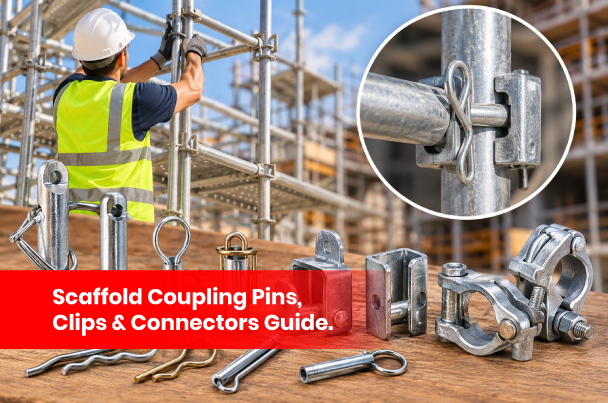
Small scaffolding parts can cause big problems when they go missing, get damaged or turn out to be the wrong size. A contractor with every scaffold frame and platform on site, ready to go. One locking pin is missing. That alone can hold up assembly.
Scaffold coupling pins, clips and connectors are the pieces that join scaffolding components together and keep them secure. Getting the right replacement means checking a few things first: the scaffold system, the component dimensions, the locking mechanism and the manufacturer specifications.
Maybe you’re swapping out worn components. Maybe you’re stocking up on spare parts before a project kicks off. Either way, this guide walks you through identifying the right connections, steering clear of compatibility mistakes and buying scaffold parts with confidence.
What Are Scaffold Coupling Pins, Clips and Connectors?
They often get lumped together, but each of these parts does a different job.
Scaffold coupling pins connect compatible scaffold frame legs when frames are stacked vertically. They line the frames up and carry loads through the connection as it was designed.
Scaffold clips and locking pins hold coupling pins (or other approved connections) in place, which helps stop parts from separating when they shouldn’t.
Scaffold connectors is the catch-all term. It covers the components used to join different scaffold sections, and the exact design depends on which scaffold system you’re working with.
Before you settle on replacement hardware, it’s worth comparing the scaffolding pins, clips, and coupling pins currently available.
Different Types of Scaffold Pins and Clips
Scaffold pins aren’t all built for the same job. Knowing the common options makes it much easier to pick the correct replacement.
| Component | Primary function | What to check |
| Coupling pin | Connects stacked scaffold frames | Diameter, length, collar, compatibility |
| Spring clip | Secures a coupling pin in a frame leg | Clip size and hole arrangement |
| Toggle pin | Locks approved frame or accessory connections | Diameter and locking design |
| Pig tail pin | Secures approved connections | Size and retaining arrangement |
| Span pin | Secures compatible casters, rails or frame connections | Dimensions and connection requirements |
| System scaffold spigot | Joins compatible system verticals | System, profile and manufacturer approval |
How to Choose the Right Scaffold Coupling Pin Size
Going by looks alone when you order a replacement coupling pin is a quick way to end up with the wrong part. The pin has to fit the scaffold frame it’s meant for and match that frame’s approved connection design.
1. Measure the Coupling Pin Diameter
Start with the outer diameter the pin needs, then check the internal dimensions of the frame leg. Here’s an example. Scaffolds Supply lists a 9-inch coupling pin with a 1-7/16-inch outer diameter, made for a frame leg with a 1.69-inch outer diameter. Those figures belong to that specific product, though. They aren’t universal.
2. Check the Overall Length and Collar
Length and collar both need to match the connection you’re working with. Do the two pins look alike? Don’t assume they’re interchangeable.
3. Verify the Locking Holes
Look at where the holes sit, how big they are and whether they line up. And never force a part into place, or modify the connection, just to make it fit.
4. Confirm Manufacturer Compatibility
Compare part numbers against your scaffold specifications. Still unsure? Send the supplier the system name, frame model, measurements and a few photos.
Scaffold Spring Clips vs. Toggle Pins: What Is the Difference?
Spring clips and toggle pins both secure scaffold connections. That doesn’t make them automatically interchangeable. You’ll usually find a spring clip holding a coupling pin in a lower frame leg, while toggle pins tend to show up in approved upper connections and on certain accessories.
So before you order, confirm three things: which connection needs securing, which pin type is specified, and what hole and retaining arrangement it calls for. One firm rule here. Never swap an approved retaining device for an improvised fastener.
How to Match Replacement Connectors to Your Scaffold System
Frame Scaffolding
Coupling pins, spring clips and other approved retaining pins are standard on frame scaffolds. Match the dimensions, and stick to the manufacturer’s requirements.
Ringlock and Cuplock Scaffolding
These modular systems depend on connections built for that specific system. You’ll sometimes see coupling or spigot products marketed for more than one system, but documented compatibility has to be in place before any of them goes into use.
Tube and Clamp Scaffolding
With tube-and-clamp scaffolds, main tube connections normally rely on purpose-designed couplers, so frame stacking pins usually aren’t part of the picture. Confirm the coupler type and tube specifications.
Signs That Scaffold Pins and Clips Need Replacement
- Coupling pins that are bent or deformed
- Retaining clips that are cracked or broken
- Corrosion that affects fit or locking function
- Locks that are missing or damaged
- Worn holes or damaged collars
- Connections sitting outside approved tolerances
Spot any of these? Take the questionable component out of service until a competent person has assessed it.
Want a more complete inspection checklist? Read Signs It’s Time to Replace Scaffold Clamps and Couplers.
Common Mistakes When Ordering Scaffold Replacement Parts Online
Ordering Based Only on Price
A cheap part is no bargain if it doesn’t fit the approved scaffold connection. Simple as that.
Assuming All Coupling Pins Are Universal
Two pins can look almost identical and still not be approved for the same frame or system.
Forgetting Retaining Clips
Are the clips included, or do you have to order them separately? Check before you check out.
Mixing Components From Different Systems
Don’t do it without approved compatibility documentation. No exceptions.
Ordering Without Checking Inventory
Count what’s missing and what’s damaged before you place an order. It’ll save you a second (or third) shipment.
Scaffold Replacement Parts Ordering Checklist
Run through this quickly before you hit order.
| Check | What to confirm |
| Scaffold system | Frame, Ringlock, Cuplock, or tube and clamp |
| Part type | Coupling pin, spring clip, toggle pin, or connector |
| Dimensions | Diameter, length, collar, hole spacing |
| Compatibility | Approved model and manufacturer |
| Accessories | Required retainers included or ordered separately |
| Quantity | Replacement counts and suitable spare stock |
| Delivery | Availability before the planned work |
Buy Scaffold Coupling Pins and Replacement Parts from Scaffolds Supply
Tracking down the right small scaffold parts shouldn’t turn into a major purchasing headache. Scaffolds Supply stocks scaffold coupling pins along with other accessories such as spring clips, toggle pins, pig tail pins, span pins and system scaffold connectors.
Head over to Scaffolds Supply to browse the scaffold parts available and compare specifications. Got a compatibility question? Talk to the sales team before you order.
Frequently Asked Questions
What is a scaffold coupling pin used for?
It joins compatible scaffold frame legs when you stack frames, and it helps keep the approved connection aligned.
Are all scaffold coupling pins the same size?
No. Diameter, length, collar and hole arrangements all vary, so check the manufacturer’s specifications.
Can I use a toggle pin instead of a spring clip?
Only if the approved connection details allow that substitution. The two aren’t universally interchangeable.
How do I identify the correct replacement scaffold connector?
Look at the system, brand, model, dimensions and original part number, plus the manufacturer-approved connection design.
Can Ringlock and Cuplock scaffolding use the same coupling pin?
Only when that exact component is documented as compatible and approved for the configuration you plan to use.
Should rusty scaffold clips be replaced?
If corrosion is affecting strength, fit or locking function, a competent person needs to assess it. In the meantime, take questionable parts out of service.