


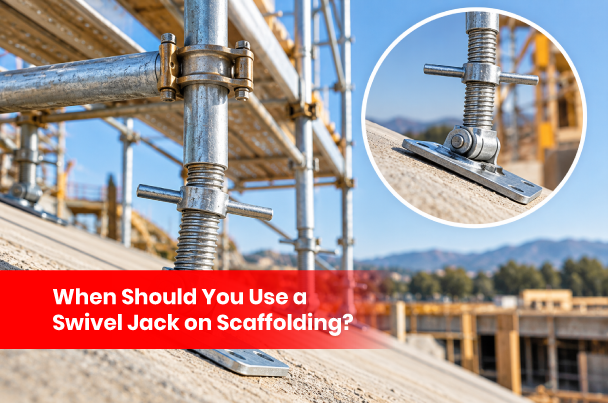
Not every construction site hands you flat ground. Contractors regularly deal with sloped concrete, inclined surfaces, pitched roofs and spots where the supporting surface changes elevation. Any of these can make a scaffolding setup a lot trickier.
So where does a swivel jack fit in? You would use one on scaffolding when an approved scaffold design calls for an adjustable base that can line up with an inclined supporting surface. The difference from a fixed-base leveling jack is the base plate. On a swivel jack it pivots, following the angle of the surface, and you still get vertical height adjustment.
One thing needs saying up front, though. A swivel jack won’t turn an unsafe slope into a suitable one for scaffolding. The supporting surface, the jack capacity, the base restraint and the entire scaffold configuration still have to meet the manufacturer’s instructions and any applicable safety requirements.
Below, we cover when a swivel screw jack is useful, how it compares with other scaffold leveling jacks, and what contractors should check before picking one.
What Is a Swivel Jack in Scaffolding?
A swivel jack is an adjustable support component that sits at the bottom of a compatible scaffold frame or vertical standard. Most have three main parts: a threaded steel stem for height adjustment, an adjustment nut and a pivoting base plate.
That base plate is what sets it apart from a standard screw jack. On a standard jack, the plate is generally fixed. On a swivel jack, it can pivot relative to the threaded stem.
If your job involves inclined supporting surfaces, Scaffolds Supply offers adjustable swivel jacks for compatible scaffolding applications.
When Should You Use a Swivel Jack on Scaffolding?
A swivel jack can help when the supporting surface is inclined and a fixed base plate can’t give you an appropriate bearing arrangement. That decision still has to follow the site assessment and the approved scaffold configuration.
1. When Scaffolding Is Installed on Sloped Ground
On sloped ground, a swivel base jack can handle an approved surface inclination, while the threaded stem lets you adjust the height of individual scaffold legs. Before you install anything, confirm three things. Is the slope suitable? Is the base restrained against sliding where that’s required? And can the ground bear the design loads?
2. When Working on Pitched Roofs
Some specialized arrangements need support on a pitched roof. A swivel screw jack may be part of an engineered solution there. Even so, roof strength, slip prevention, overall stability, fall protection and the approved support design all have to be assessed. On its own, a swivel jack does not make roof-supported scaffolding safe.
3. When the Supporting Surface Has Varying Angles
Inclined surfaces turn up on industrial and infrastructure sites from time to time. Where the scaffold designer has approved it, swivel jacks can adapt to those angles, so nobody has to force a fixed plate into incomplete contact with the surface.
4. When Standard Base Jacks Cannot Provide Suitable Contact
A fixed-base scaffold leveling jack usually suits horizontal surfaces that have been properly prepared. Put it on an incline and things change. A compatible swivel jack may give you the correct angular alignment there. What it can’t do is fix weak ground or inadequate foundations.
Swivel Jack vs. Standard Scaffold Leveling Jack
| Feature | Swivel jack | Standard leveling jack |
| Base plate | Pivoting | Fixed |
| Typical use | Approved inclined surfaces | Level supporting surfaces |
| Height adjustment | Yes | Yes |
| Key selection checks | Angle, load, restraint, compatibility | Load, bearing, compatibility |
Both products give you height adjustment. Which one is right comes down to the scaffold system and the conditions on site. Want more information? Read the existing guide to a scaffold leveling jack and its applications.
How to Choose the Right Swivel Screw Jack
Check Scaffold System Compatibility
Start by identifying the scaffold system: frame scaffolding, Ringlock, Cuplock and so on. Jacks that look alike aren’t necessarily interchangeable.
Confirm the Stem Diameter
The threaded stem has to match the scaffold component it fits into, along with that component’s approved specifications. For reference, Scaffolds Supply lists a 24-inch swivel jack with a 1-3/8-inch stem. Before you order, check that product’s current details and your scaffold manufacturer’s specifications.
Check the Adjustment Range
Measure how much the base height needs to change. Keep the jack within its permitted extension range, and never overextend it to make up for unsuitable ground.
Review the Base Plate and Supporting Surface
Look at the plate size, bearing area and swivel angle, plus any restraint or load-distributing support the setup requires. Under the design loads, the base has to stay stable.
Verify Capacity and Condition
Confirm the rated capacity for the arrangement you intend to use. Then inspect the threads, stems, base plates and swivel joints. Anything damaged comes out of service.
Can You Use a Swivel Base Jack on Any Slope?
No. A swivel base jack can handle a limited, approved inclination. It doesn’t remove the sliding and stability risks that come with a slope. The allowable angle, base restraint, bearing capacity, bracing, ties and load path all need to be verified.
- Confirm the manufacturer’s permitted swivel angle and extension.
- Assess how strong the support is and whether sliding could occur.
- Use the foundation and restraint arrangement shown in the approved design.
- Never improvise a base with loose blocks or unsuitable packing.
Common Mistakes to Avoid When Using Swivel Jacks
Using the Wrong Size
Measure the stem and connection dimensions you need.
Overextending the Jack
Stay within the manufacturer’s maximum permitted working extension.
Ignoring Surface Strength
Even the correct jack needs a suitable foundation or engineered support underneath it.
Assuming the Swivel Prevents Sliding
It doesn’t. A pivoting plate won’t, by itself, restrain movement along a slope.
Using Damaged Parts
Bent stems, cracked plates, damaged threads, defective swivel mechanisms.
Swivel Jack Selection Checklist for Contractors
Use this as a quick check before you order.
| Check | What to verify |
| System | Approved scaffold type and model |
| Slope | Permitted angle and restraint |
| Stem | Correct diameter and fit |
| Adjustment | Within permitted extension |
| Base | Appropriate plate and support |
| Capacity | Sufficient rated load |
| Condition | No damage or defective threads |
Find the Right Swivel Jack at Scaffolds Supply
Getting the right scaffold base components makes it easier for contractors to plan a safe, efficient setup. Scaffolds Supply offers swivel jacks along with other adjustable scaffold support products. Go through the published specifications and confirm your equipment is compatible before you order.
Visit Scaffolds Supply to compare the options available. Or contact the sales team and share your scaffold model, required dimensions and jobsite requirements.
Frequently Asked Questions
What is the purpose of a swivel jack in scaffolding?
It gives adjustable base support to an approved scaffold configuration that sits on an inclined supporting surface.
How is a swivel screw jack different from a regular screw jack?
It comes down to the base plate. A swivel screw jack’s plate pivots, whereas a standard screw jack usually has a fixed one.
Can a swivel base jack be used on a pitched roof?
Only as part of an engineered, approved scaffold arrangement with adequate roof support, restraint and safety controls.
Is a scaffold leveling jack needed on uneven ground?
An adjustable leveling jack may be used to account for elevation changes, as long as the whole support arrangement meets the approved design.
Can Ringlock and Cuplock use the same swivel jack?
Some products are sold for both systems. You still need to confirm the exact dimensions, loading and manufacturer approval.
How can I choose the correct size?
Check the scaffold model, stem dimensions, base size, adjustment range and capacity, along with manufacturer-approved compatibility.