


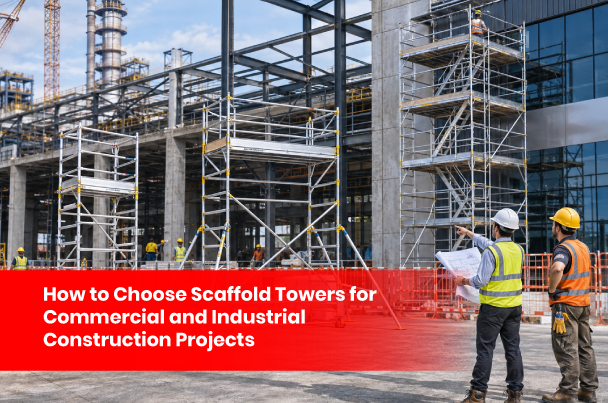
Picking scaffold towers for a commercial or industrial job comes down to a handful of things: working height, load capacity, ground conditions, mobility and safety requirements. Get those right and most other decisions get easier. If your crew needs to move around a lot, rolling scaffold towers make sense. If the work stays in one spot, a non-rolling tower gives you fixed, steady access.
At Scaffolds Supply, we supply scaffolding equipment for commercial and industrial construction. Our range covers rolling scaffold towers along with other access equipment, so you can match the kit to what each project actually needs.
In this guide, we’ll walk through the main types of scaffold towers, the factors that matter most when you’re choosing one, key safety considerations and the buying mistakes that come up most often.
What Are Scaffold Towers and Where Are They Used?
Scaffold towers are temporary raised structures. Give workers a stable platform for construction, installation, inspection and maintenance tasks at height.
Large facade scaffolding wraps around a whole building. A scaffold tower doesn’t. It gets you to a specific work area, so there’s no need for continuous scaffolding across the entire structure.
You usually find them working jobs like these:
- Renovation and construction of commercial premises
- Installation and maintenance of industrial equipment
- Ceiling work and warehouse lighting
- Electrical and mechanical installations.
- Exterior painting and façade repairs
- Maintenance and shutdown operations in factories
The right tower setup depends on how high you need to go, the environment you’re working in, and the weight of the equipment going up with you.
What Types of Scaffold Towers Are Used in Construction?
Each tower configuration strikes its own balance between mobility, access and stability.
1. Rolling Scaffold Towers
Rolling scaffold towers sit on wheels or casters, so you can move them from one work area to the next.
They’re a common sight in warehouse maintenance, indoor construction, painting and installation work.
Key benefits are:
- Increased mobility between work sites
- Good for repetitive maintenance tasks
- Less disassembly required
- Flexible access over large indoor areas
One caveat though. Rolling towers should have appropriate locking devices and should only be used on surfaces capable of supporting them.
2. Non-Rolling Scaffold Towers
Non-rolling towers stand on fixed base supports rather than wheels.
They work well when the crew will be in the same spot for a long stretch of the build.
For fixed access on commercial construction sites, contractors can consider non-rolling scaffold towers.
3. Modular and System Scaffold Towers
Modular towers are built from standardized components that can be put together in different configurations.
In industrial facilities with complex access layouts, several working elevations or specialized setups, Ringlock and other system scaffolding arrangements may be a good fit.
Whichever system you go with, it has to meet the relevant engineering and manufacturer requirements.
How to Choose the Right Scaffold Tower for Your Project
Choosing scaffold towers really means matching the equipment specs to the conditions you will face on site.
1. Determine Working Height and Platform Height
People mix these two up all the time, but working height and platform height aren’t the same measurement.
Platform height is the level workers stand on. Working height is the elevation where the actual task gets done.
Before selecting a tower:
- Measure the required working elevation.
- Check the manufacturer’s permitted tower height.
- Evaluate required access arrangements.
- Determine whether additional stabilization is necessary.
And don’t extend a tower beyond its approved configuration.
2. Evaluate Load Capacity
In commercial and industrial jobs, workers rarely go up empty-handed. Tools, equipment and construction materials all add weight.
So start by working out the combined load you expect from workers, tools and materials.
Under OSHA 29 CFR 1926.451(a)(1), scaffolds generally must support their own weight plus at least four times the maximum intended load, unless a specific exception applies.
That doesn’t replace the manufacturer’s numbers. Contractors still have to stay within the rated load capacity and approved configuration.
3. Check Ground Conditions and Stability
The stability of the tower is determined by the ground on which it is built. This is an important determinant of whether the tower can be used safely.
Pre-Installation check List:
- Ground stability and bearing capacity
- Ground surface and slope
- Requirements for foundation base
- Drainage and settling considerations
- Outrigger/Stability considerations
Uneven ground may require additional work to level the ground.
4. Choose Between Steel and Aluminum Towers
The material you choose determines how easy it will be to handle and transport, how well it will resist corrosion, and how much maintenance it will require.
| Factor | Aluminum Towers | Steel Towers |
| Weight | Generally lighter | Generally heavier |
| Handling | Easier to transport | May require more effort |
| Corrosion resistance | Naturally corrosion resistant | Depends on coating |
| Applications | Mobile access and maintenance | Commercial and industrial work |
| Load capacity | Design-dependent | Design-dependent |
Don’t assume either material will carry more load. Check the manufacturer’s specifications first.
What Safety Features Should Industrial Scaffold Towers Include?
Safety features are even more crucial on a busy construction site.
In the case of choosing industrial scaffold towers, it is necessary to ensure the inclusion of the following parts:
- Guardrails: Fall protection around the elevated work platform.
- Decking of Platforms: Platforms are solidly supported and anchored.
- Bracing: Structural bracing and connections safely installed.
- Access System:adequate ladder, stairs or approved access system.
- Caster Locks: rolling towers caster locks.
- Stabilizers: Outriggers, tie-downs or approved stabilizer system.
All the above parts should be compatible with the scaffolding system chosen.
What OSHA Requirements Apply to Mobile Scaffold Towers?
OSHA 29 CFR 1926.452(w) sets out specific safety requirements for mobile scaffolds.
The key ones include:
- Mobile scaffolds must be plumb, level, and square.
- Bracing connections must be properly secured.
- Wheels and casters must be locked while the scaffold is used in a stationary position.
- Scaffolds must be stabilized against tipping during movement.
- Caster stems must be secured to scaffold legs or adjustment screws.
- Workers must be informed before scaffold movement.
As a rule, employees can’t ride on a moving scaffold unless the specific conditions set out by OSHA are met.
Contractors should also keep up with the applicable inspection, access, fall protection and training requirements.
Scaffold Tower Selection Checklist for Commercial Contractors
Run through this checklist when you’re comparing commercial scaffolding equipment.
| Selection Factor | What to Check |
| Project application | Commercial, industrial, or maintenance |
| Working height | Required platform elevation |
| Load capacity | Manufacturer’s rated working load |
| Tower type | Rolling, non-rolling, or modular |
| Material | Steel or aluminum |
| Ground conditions | Bearing capacity and stability |
| Safety features | Guardrails, braces, and access |
| Mobility | Casters, locks, and stabilizers |
| Compatibility | Approved system components |
| Maintenance | Inspection and replacement parts |
Before you make a final call, weigh up purchase costs, transportation, assembly requirements and how often you’ll reuse the equipment.
Common Mistakes to Avoid When Choosing Scaffold Towers
The wrong equipment can push project costs up. Worse, it can put your crew at risk.
Common mistakes include:
- Choosing towers based only on purchase price.
- Confusing working height with platform height.
- Ignoring manufacturer load ratings.
- Using rolling towers on unsuitable surfaces.
- Overlooking outriggers and stabilization requirements.
- Mixing incompatible scaffolding components.
- Failing to consider future equipment maintenance.
If your project needs base-level adjustments, take a look at our available scaffold socket jacks and confirm they’re compatible with your tower configuration.
Conclusion
Getting scaffold towers right for commercial and industrial construction means taking a careful look at working height, load capacity, mobility, site conditions and safety requirements.
Rolling scaffold towers give you flexibility when the work keeps moving. Non-rolling towers suit fixed working locations. And for more complex industrial access requirements, modular systems may be the better option.
Looking for reliable scaffold towers for your next construction project?
At Scaffolds Supply, we offer scaffold towers, system components and accessories for commercial and industrial applications. Browse our products to find scaffolding equipment that fits your project specifications, access requirements and budget.