


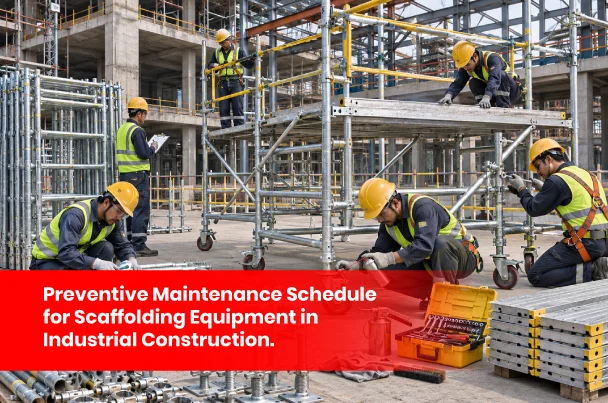
A preventive maintenance schedule gives industrial contractors a way to spot damaged scaffolding components, keep corrosion in check, cut down on equipment downtime and keep working platforms safer. A good construction equipment maintenance program covers four basics: pre-shift inspections, scheduled cleaning, component servicing and proper storage.
Reactive repairs wait for something to go wrong. Preventive maintenance works the other way round, catching problems early, before the equipment turns unsafe or needs a costly replacement.
That’s where we can help. Scaffolds Supply stocks scaffolding systems and replacement components for industrial construction and maintenance work. So if you’re mapping out a maintenance plan (or just need to swap a few worn parts), our scaffold parts and accessories are a good place to start.
Why Is Preventive Maintenance Important for Scaffolding Equipment?
Industrial scaffolding takes a beating. It’s put up, taken down, moved between sites and used in tough working conditions, again and again.
Skip the maintenance and problems start to pile up. Corrosion creeps in. Connections get knocked about, platforms wear thin and the odd component goes missing. Bit by bit, the equipment becomes less reliable.
Put a proper maintenance program in place, though, and you’ll be able to:
- Catch damaged or deteriorating parts before they turn into a bigger problem.
- Cut down on downtime nobody saw coming.
- Get more years out of equipment that’s still in good shape.
- Keep repair and replacement spending under control.
- Know what’s in your equipment inventory, with records that stay accurate.
- Keep safety inspections consistent from one job to the next.
Scaffolding maintenance has a lot in common with heavy equipment maintenance. Both need planned inspections, preventive action and someone clearly responsible for the condition of the equipment.
Preventive Maintenance Schedule for Scaffolding Equipment
How you organize maintenance should depend on how often the equipment is used, what it’s exposed to and what the manufacturer recommends.
The schedule below is a practical place for industrial construction contractors to start.
| Frequency | Maintenance Activities | Responsible Team |
| Before each shift | Inspect visible defects, platforms, supports, braces, and connections | Competent person |
| Weekly | Review component condition, corrosion, and connection wear | Maintenance team |
| Monthly | Inspect stored inventory, protective coatings, and reusable components | Equipment supervisor |
| Quarterly | Review equipment condition, repair history, and replacement needs | Maintenance manager |
| After unusual events | Inspect affected scaffolds after impacts, storms, or other potentially damaging events | Competent person |
| Before reuse | Verify stored components are suitable for assembly | Qualified inspection personnel |
A quick note on the weekly, monthly and quarterly intervals. They’re suggested maintenance practices, not universal OSHA inspection frequencies. Your actual schedule should reflect the equipment’s condition and the manufacturer’s instructions.
Daily Scaffolding Inspection and Maintenance Checklist
OSHA is clear on this one. Its rule at 29 CFR 1926.451(f)(3) says a competent person must check scaffolds and their components for visible defects before every work shift, and again after anything happens that could affect structural integrity.
1. Inspect Frames, Standards, and Braces
Walk the structure and look closely for:
- Cracks, bends or any part that’s visibly out of shape
- Heavy corrosion, or coatings that have been damaged
- Locking pins and connectors that have gone missing
- Braces that are loose or haven’t been secured properly
- Any sign the scaffold has been overloaded or hit
Found something? Nobody goes back up until that component has been assessed and sorted out.
2. Check Platforms and Scaffold Planks
Your crew stands on these all day, so they need to stay stable and handle the loads they were built for.
Keep an eye out for:
- Planks that are cracked, bent or starting to deteriorate
- Gaps where platform sections are missing
- Hooks or locking devices that are damaged
- Decking that isn’t properly supported or secured
- Slippery spots and built-up debris
Need to replace damaged platform parts? Our range of scaffold planks is worth a look.
3. Verify Guardrails and Access Systems
Check guardrails, access gates, ladders and the connections that hold them together.
Make sure every required protective component is installed correctly and doing its job.
Damaged access equipment or missing fall protection? That has to be fixed before work in the affected area carries on.
Weekly and Monthly Scaffolding Maintenance Tasks
Pre-shift inspections deal with immediate safety. Scheduled maintenance looks further ahead, picking up equipment problems while they’re still developing.
Weekly Maintenance Activities
- Clear off dirt, debris and any concrete residue that’s built up.
- Take a close look at joints, connectors and locking mechanisms.
- Check the parts you can reach for corrosion or coatings that are breaking down.
- Look over reusable equipment for cracks or deformation.
- Pull damaged parts out and keep them apart from serviceable stock.
Monthly Maintenance Activities
- Go through the scaffolding inventory you’ve got in storage.
- Check steel parts for any sign of corrosion.
- See whether protective coatings are wearing or breaking down.
- Inspect connection points and anything adjustable.
- Make sure ID labels and component specs are still correct.
- Look back at repair records and note any defects that keep coming up.
For cleaning, lubrication and servicing, go by the procedures the manufacturer has approved. Structural modifications and unauthorized repairs are off the table.
How Should Contractors Maintain Different Scaffolding Components?
Each scaffold component wears differently, so each one needs its own maintenance approach.
| Component | Maintenance Focus |
| Steel frames | Corrosion, cracks, deformation |
| Aluminum planks | Bending, cracks, damaged hooks |
| Screw jacks | Thread damage, corrosion, adjustment |
| Braces and connectors | Wear, missing pins, deformation |
| Guardrails | Damage, secure connections |
| Casters | Wheel condition, locks, attachment |
| Base plates | Bending, corrosion, stability |
Clean and inspect equipment before it goes into storage or back out to a site.
And when you replace a component, confirm it’s compatible with your existing scaffolding system and the manufacturer’s specifications.
How to Prevent Corrosion and Equipment Damage During Storage
Storage is a bigger part of construction equipment maintenance than many people realize, especially when the same equipment moves across several industrial projects.
Rain, chemicals and poor storage conditions can all speed up deterioration.
A few simple habits make a real difference:
- Keep components in a dedicated storage area that drains well.
- Keep equipment out of the wet wherever you can.
- Give components a clean before they go into long-term storage.
- Store damaged materials separately from serviceable ones.
- Use proper racks so nothing gets bent out of shape.
- Keep connection surfaces free from contamination.
- Don’t stack equipment higher than is safe.
Galvanizing helps against corrosion, sure. But galvanized parts still need regular checks and sensible storage like everything else.
How to Document Scaffolding Maintenance Activities
A simple maintenance log goes a long way. Over time, it shows you how each piece of equipment is holding up, which defects keep coming back and what was done to fix them.
Here’s what’s worth recording:
| Record Field | Information |
| Equipment ID | ID for the scaffold or component |
| Inspection date | When and where the inspection took place |
| Component condition | Serviceable or defective |
| Defect details | Any damage, wear or corrosion found |
| Corrective action | Repaired, replaced or removed |
| Responsible person | The employee assigned to it |
| Final status | Approved for use or removed from service |
Strictly speaking, federal OSHA doesn’t usually require you to write down routine competent-person scaffold inspections under 1926.451(f)(3). Keeping records anyway pays off. You’ll manage your equipment better internally, and there’s a clear trail of who did what on the project.
When Should Scaffolding Equipment Be Repaired or Replaced?
Some damaged components simply can’t go back into service safely.
OSHA 1926.451(f)(4) says components weakened below required strength levels must be repaired, replaced, appropriately braced or removed from service until they’re repaired.
Replacement may be needed when equipment has:
- Structural cracks or significant deformation
- Severe corrosion affecting strength
- Damaged or unreliable locking mechanisms
- Broken platform supports
- Missing or incompatible critical components
Before any repaired component goes back into use, contractors should follow the manufacturer’s specifications and get an appropriate technical evaluation.
Conclusion
Managing scaffolding equipment across an industrial construction project really depends on having a preventive maintenance schedule.
It comes down to daily inspections, scheduled servicing, correct storage and good maintenance records. Put those together and you’ll catch defects early, avoid downtime you didn’t need and get more life out of your equipment.
Your heavy equipment maintenance or construction machinery maintenance program might already take care of powered machinery. Scaffolding doesn’t fit neatly into that. It needs its own inspection and servicing routine, built around individual components.
Looking for reliable scaffolding equipment and replacement components?
At Scaffolds Supply, we provide scaffolding systems, accessories and components for commercial and industrial construction projects. Browse our products for your equipment replacement needs and to keep your construction operations running over the long term.