


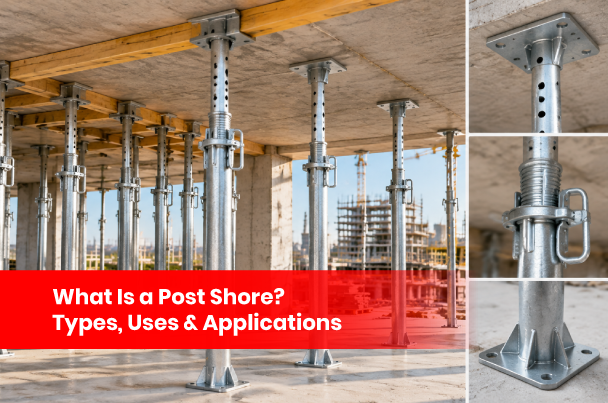
Concrete, formwork, beams, slabs, they all need temporary structural support at some point while they’re being installed, repaired, or modified. That’s exactly where a post shore earns its keep in temporary shoring and construction shoring work.
A post shore is a temporary vertical support built to resist compressive loads and hold structural elements in place during specific stages of construction. Most come in adjustable configurations, which lets contractors match different working heights and project requirements without switching equipment.
Not every post shore fits every job, though. Height, loading, adjustment range, base conditions, configuration, and manufacturer specifications all factor into picking the right product.
This guide covers what post shores actually are, the types you’ll run into, where they get used, and what to weigh when you’re choosing the right temporary support.
What Is a Post Shore?
A post shore is a temporary supporting member that resists compressive forces and holds vertical support during construction activities.
OSHA defines a shore as a supporting member that resists a compressive force imposed by a load. In concrete construction, shoring often forms part of the larger formwork system supporting freshly placed or partially cured concrete.
Unlike a permanent structural column, a post shore isn’t meant to stay. Once the supported structure reaches the required condition, or the temporary support just isn’t needed anymore, crews remove the shores according to the project’s plans and specifications.
Post shores, sometimes called shoring posts, show up in:
- Concrete slab construction
- Beam support
- Formwork
- Structural repairs
- Renovation projects
- Temporary structural support
- Commercial and industrial construction
Which application fits depends on the product itself and the project’s engineering requirements.
How Does a Post Shore Work?
A typical adjustable post shore is built from vertical steel components, an adjustment mechanism, and contact surfaces top and bottom.
That adjustment mechanism lets you set the shore at the working height you need. Once it’s positioned correctly, the shore carries the load straight down through the post and into the supporting surface underneath.
A post shore isn’t something to think about in isolation, though. How well it performs comes down to the whole shoring arrangement: the supporting surface, load distribution, alignment, spacing, and whatever bracing the job calls for.
For formwork applications, OSHA requires the entire formwork system to be designed, fabricated, erected, supported, braced, and maintained so it can handle the vertical and lateral loads reasonably expected to hit it.
That’s why temporary shoring needs to follow project-specific drawings, specifications, and manufacturer instructions, not just get dropped in wherever support looks needed.
What Are Post Shoring Jacks?
Post shoring jacks are the adjustment mechanisms in temporary shoring systems, the part that gets a support positioned at the right height.
Depending on the design, they let you make fairly fine height adjustments after the shore’s already roughly in place.
They earn their spot when:
- Working heights vary between floors
- Slab or beam elevations differ
- Formwork needs precise positioning
- Temporary supports need to land within a specific range
- The shoring system has to flex across different projects
Adjustment range, operating method, and allowable loads all vary by product, so check the specific manufacturer’s information before choosing or using a post shoring jack.
Types of Post Shores
Post shores come in different designs and configurations built for different construction needs. Knowing the main types makes it a lot easier to figure out which one actually fits a given project.
Adjustable Post Shores
Adjustable post shores are built to accommodate different working heights within a set range.
That adjustability is what makes them useful on projects where the distance between the supporting surface and the structure changes from spot to spot.
Common applications include:
- Concrete formwork
- Temporary slab support
- Beam support
- Renovation work
- Structural modifications
- Temporary construction support
Flexibility is the big draw here. One shore type can often work at several different heights within its range, which is exactly why contractors jumping between projects lean on them.
That said, never look at maximum extension on its own. It has to be weighed against the product’s allowable loading and configuration together.
Heavy Duty Post Shores
Heavy duty post shores step in when temporary support needs go beyond what lighter-duty shoring equipment can handle.
They tend to show up in:
- Heavier formwork
- Larger structural members
- Concrete construction
- Industrial projects
- Temporary support during structural modifications
Don’t treat “heavy duty” as some fixed load classification. It isn’t one. Actual capacity comes down to the specific product, working height, configuration, and the manufacturer’s rated specifications.
So the right move is comparing your project’s requirements against the manufacturer’s technical data, not just grabbing something because the label says heavy duty.
Steel Post Shores
A steel post shore uses steel as the main structural material for the post itself.
Steel gets used a lot in temporary shoring because it delivers a strong, durable support structure while still letting manufacturers build adjustable, reusable systems out of it.
Steel post shores work well for:
- Concrete formwork
- Slab support
- Beam support
- Renovation
- Commercial construction
- Repeated construction applications
The material alone doesn’t decide how much load a shore can safely carry, though. Design, dimensions, adjustment position, connections, bearing conditions, and the full shoring arrangement all play a part.
Different Post Shore Configurations
Post shores also differ in overall design, adjustment mechanism, height range, base and top plate configuration, and intended application.
Some handle straightforward vertical support and nothing more. Others are one piece of a much larger engineered shoring or formwork system.
When you’re comparing products, don’t just eyeball them. Review:
- Working height
- Adjustment range
- Product dimensions
- Rated capacity
- Base and top plate design
- Material
- Manufacturer requirements
- Intended application
Where Are Post Shores Used?
Post shores turn up across a wide range of construction and structural-support applications. Depending on the project, shoring posts might be one piece of a larger engineered temporary support arrangement.
Concrete Construction
Temporary support during concrete construction is probably the most common use you’ll see.
Freshly placed concrete puts real weight on everything below it, weight that needs proper support until the structure reaches its required strength. Shoring often forms part of the overall formwork system carrying that load.
OSHA requires formwork to be designed and supported so it can withstand reasonably anticipated vertical and lateral loads.
Slab and Beam Support
Post shores provide temporary vertical support underneath slabs and beams whenever the project’s design calls for it.
They come into play during construction, or while structural work is getting finished, depending on the specific application.
Don’t pick the number and arrangement of shores based on a single post’s capacity alone. The overall load distribution and supporting structure need consideration too.
Formwork and Shoring
Post shores can be part of formwork shoring systems used during concrete construction.
Here, the shores work alongside other components to support both the formwork and the loads that concrete placement creates.
OSHA requires formwork drawings or plans, jack layouts and shoring equipment information included, to be available at the jobsite for applicable cast-in-place concrete operations.
Renovation and Structural Repair
Renovation projects need temporary shoring often, especially when existing structural elements are getting modified.
Depending on the project, temporary support might be needed while:
- Structural walls are modified
- Beams are repaired or replaced
- Openings are created
- Existing structures are reinforced
- Damaged structural elements are repaired
Existing buildings tend to have complicated load paths, so temporary support for structural modifications needs to come from an appropriate project-specific design, not guesswork.
Commercial and Industrial Construction
Commercial and industrial projects need temporary vertical supports too, during construction, modifications, maintenance, and structural work.
In these situations, construction shoring provides that temporary support as part of a properly designed system.
Which type and arrangement of shoring makes sense depends on the project, the loads, the working heights, the structural design, and the construction sequence.
How to Choose the Right Post Shore
Choosing the right post shore takes more than just figuring out the height you need. Several factors have to be weighed together, not one at a time.
Determine the Required Working Height
Start by measuring the distance between the supporting surface and whatever element needs temporary support.
Consider:
- Floor-to-ceiling height
- Slab elevation
- Beam elevation
- Formwork height
- Required adjustment range
Keep the shore within its specified working range. And don’t assume extending it to maximum height means it’ll support the same load it would at a lower one. It usually won’t.
Check the Required Load
Expected load might be the single most important factor in choosing temporary support.
Depending on the application, that load can come from:
- Concrete
- Formwork
- Structural members
- Workers
- Tools
- Construction materials
- Equipment
The overall shoring system needs to be designed around whatever loads the construction process is expected to throw at it.
For cast-in-place concrete formwork, OSHA requires the formwork system to be capable of supporting the vertical and lateral loads that may reasonably be anticipated.
Review the Adjustment Range
An adjustable shore needs a working range that actually fits the project.
Too little adjustment and it won’t reach the position you need. Push a shore beyond its intended adjustment range and you end up with a configuration that just isn’t suitable.
Always check the required working height against the manufacturer’s stated adjustment range before you commit.
Consider Base and Top Plate Requirements
The top and bottom of the shore need proper contact with the supported structure and the supporting surface. No exceptions here.
That supporting surface has to carry the intended load. OSHA specifically requires sills used for shoring to be sound, rigid, and capable of carrying the maximum intended load, and it requires base plates, shore heads, extension devices, and adjustment screws to be in firm contact wherever that applies.
Alignment matters just as much. Position the shore according to the actual design, not an improvised setup someone threw together on-site.
Check Manufacturer Specifications
Before you settle on a post shore, go through the manufacturer’s technical information.
Important details include:
- Working height
- Adjustment range
- Rated capacity
- Product dimensions
- Material
- Base and top plate configuration
- Approved applications
- Installation requirements
- Inspection requirements
Two post shores can look nearly identical in dimensions and still have completely different capabilities. Never assume otherwise.
Post Shore vs. Other Temporary Shoring Systems
Post shores are just one type of temporary support equipment out there. Depending on the project, another system might actually be the better call.
| Feature | Post Shore | Other Temporary Shoring Systems |
| Primary function | Vertical temporary support | Varies by system |
| Height adjustment | Often adjustable | Depends on system |
| Typical applications | Slabs, beams, formwork | Depends on design |
| Configuration | Individual supports or engineered arrangement | May use frames, towers, props, or other components |
| Reusability | Often reusable | Depends on product |
| Selection | Height, load, configuration and specifications | System-specific requirements |
No single temporary shoring system wins for every project. The right choice comes down to structural requirements, construction sequence, available space, loads, and project design.
Safety Considerations When Using Post Shores
Temporary shoring is structural-support work, plain and simple, so safety needs attention across planning, installation, use, inspection, and removal.
Important considerations include:
- Follow the manufacturer’s instructions.
- Use the correct product for the intended application.
- Do not exceed the specified capacity.
- Use suitable and stable supporting surfaces.
- Maintain proper alignment.
- Avoid unintended eccentric loading.
- Inspect components before use.
- Do not use damaged or weakened shoring equipment.
- Provide required bracing according to the design.
- Follow project-specific drawings and specifications.
OSHA requires shoring equipment to be inspected before erection for applicable cast-in-place concrete work, and erected shoring has to be inspected immediately before, during, and immediately after concrete placement. Damaged equipment that doesn’t meet the required strength has no place being used.
OSHA also prohibits eccentric loads on shore heads and similar members unless those members were specifically designed to take that kind of loading.
So post shores aren’t simple “place-and-support” equipment, whatever it might look like on the surface. The complete shoring arrangement and construction sequence both matter.
Common Mistakes to Avoid
Exceeding the Intended Load
Assuming a post shore can handle more weight than its specified capacity ranks among the most serious mistakes out there.
Always check the product documentation and project requirements before you load it up.
Ignoring Working Height
A shore’s capacity and suitability can shift with its working height. Picking a product just because it reaches the height you need isn’t enough on its own.
Using an Unsuitable Base
A weak, unstable, or unsuitable supporting surface can undermine the entire shoring arrangement, even if everything above it looks fine.
Poor Alignment
Temporary vertical supports need to be positioned and aligned the way the design specifies, not close enough.
Mixing Incompatible Components
Don’t combine components just because they look like they fit together physically. Check the manufacturer’s requirements before pairing accessories or components.
Ignoring Load Distribution
One shore’s capacity doesn’t automatically tell you the capacity of the entire shoring system.
Load distribution, spacing, supporting surfaces, structural conditions, and the overall design all factor in.
Using Damaged Equipment
Bent, cracked, heavily corroded, deformed, or otherwise weakened components have no business being used once their condition cuts into the required strength.
Skipping Inspection
Inspection isn’t a box to tick, it’s a genuine part of temporary shoring operations. For applicable concrete formwork, OSHA specifically addresses inspecting shoring equipment before erection and around concrete placement.
Final Takeaway
A post shore is a genuinely practical temporary support component used across construction, formwork, renovation, and structural work. Adjustable post shores let contractors handle different working heights, while heavy duty post shores and steel post shores cover different project requirements.
Post shoring jacks add extra adjustment where it’s needed, and shoring posts often form part of larger temporary support arrangements.
Choosing a post shore takes more than checking whether it reaches the required height, though. Working load, adjustment range, supporting surfaces, alignment, configuration, and manufacturer specifications all need consideration.
For concrete and formwork applications, temporary shoring, construction shoring, and formwork shoring arrangements need to follow applicable requirements and project-specific plans too. OSHA requires formwork and shoring to be designed and supported for the loads reasonably expected during construction, with specific requirements covering shoring inspection, bearing surfaces, alignment, and loading.
The best post shore is simply the one that matches a project’s actual structural and working requirements, not the one with the biggest size or the highest number on the spec sheet.
FAQs About Post Shores
What is a post shore?
A post shore is a temporary vertical support built to resist compressive loads during construction, renovation, formwork, and structural work. Many are adjustable, which lets them accommodate different working heights within their specified range.
What are post shoring jacks used for?
Post shoring jacks adjust and position temporary shoring supports. They help accommodate different working heights and provide adjustment during setup, depending on how the specific shoring equipment is designed.
What are adjustable post shores?
Adjustable post shores are temporary vertical supports that adjust to different working heights within a manufacturer’s specified range. They’re commonly used for formwork, slab support, beam support, and structural renovation.
What are heavy duty post shores used for?
Heavy duty post shores handle applications that need greater temporary support capability. You’ll find them in construction, concrete formwork, industrial projects, and structural work, though actual capacity always depends on the specific product and configuration.
What is a steel post shore?
A steel post shore is a temporary support built mainly from steel. Steel makes for a durable structural material in adjustable shoring equipment, but a shore’s actual capacity still comes down to its design, dimensions, configuration, and manufacturer’s specifications.
What are shoring posts used for?
Shoring posts are temporary vertical supports that help carry loads during construction, concrete formwork, renovation, repairs, and other structural work. Whether one suits your job depends on the required height, load, configuration, and project-specific design.
What is construction shoring?
Construction shoring is the term for temporary support systems that hold up structures, formwork, excavations, or other construction elements during specific stages of a project. Which shoring method fits depends on the project design, loads, structural conditions, and construction sequence.
What is formwork shoring?
Formwork shoring is the temporary support arrangement that carries formwork and the loads tied to concrete placement. Post shores can be part of these systems, but the complete arrangement still needs to be properly designed, supported, braced, and maintained.
How do I choose the right post shore?
Begin with the working height needed and loads anticipated, and compare these requirements to the adjustment range, the capacity data, the base and top plate configuration, and the intended use as indicated by the manufacturer. Include project specific drawings and engineering requirements as well.
Are post shores used for concrete formwork?
Yes. Post can be used in temporary formwork and shoring systems for concrete construction. The support and design of the complete formwork and shoring system must still be provided for the loads expected during the construction period.