


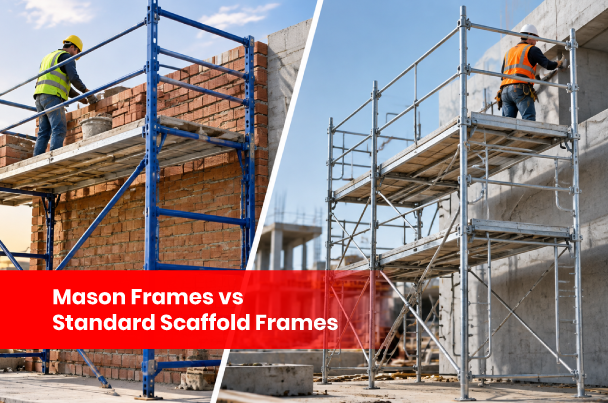
The scaffold frame you choose ends up shaping worker access, how materials get handled, platform setup, and how efficiently the whole jobsite runs. The trouble is that terms like mason scaffolding, mason scaffolding frames, walk-through frames, and standard frame scaffolds get thrown around together so often that it’s not always clear which one actually fits your project.
Put simply, mason scaffolding tends to be linked with masonry and bricklaying work, while frame scaffolding covers a much wider range of prefabricated scaffold systems used in construction, painting, maintenance, and other access work. Which one you actually need comes down to the type of work involved, how many working levels you need, access requirements, expected loads, component compatibility, and the safety rules that apply.
Mason Scaffolding Frames vs. Standard Frame Scaffolds
Mason scaffolding frames are usually set up for masonry-related jobs such as bricklaying, blockwork, plastering, and exterior wall work. Standard frame scaffolds, on the other hand, are a wider category of prefabricated frame systems that can include mason frames, walk-through frames, and several other configurations.
The real differences come down to frame design, access, working-platform requirements, and what the scaffold is actually meant for.
What Is Mason Scaffolding?
Mason scaffolding is a frame-based scaffold type that gets used when workers need an elevated platform right alongside masonry walls. It comes in handy for bricklaying, blockwork, plastering, façade work, repairs, and similar construction jobs.
The name “mason frame” doesn’t mean only masons can use it. In practice, frame scaffold systems can serve several purposes depending on how they’re configured, what accessories they carry, their rated capacity, and the manufacturer’s specifications.
What Are Mason Scaffolding Frames?
Mason scaffolding frames are prefabricated vertical frame sections that make up part of a supported scaffold structure. They connect with such things as coupling pins and cross braces. Platforms, base accessories, guardrails and other parts are added depending on how the scaffold is configured.
Frame sizes and component compatibility vary between products. So contractors should not assume that every mason scaffold frame has the same dimensions, capacities or accessories.
Before you choose a frame, check the manufacturer’s specifications and make sure the whole scaffold system is suitable for the job you are doing.
Where Is Mason Scaffolding Commonly Used?
Mason scaffolding can be suitable for projects involving:
- Bricklaying
- Concrete block construction
- Masonry wall installation
- Exterior wall finishing
- Plastering
- Building repairs
- Restoration work
- General elevated construction tasks
The goal is always the same: a properly configured working platform at the height and location the job calls for.
What Is Standard Frame Scaffolding?
Frame scaffolding is a prefabricated scaffold system made up of manufactured frame sections which are joined together with braces and other components.
Unlike piece-by-piece assembly of individual tubes and couplers, frame scaffolds are constructed from standard frame sections that are stacked vertically and connected to form working levels.
Standard frame scaffolds show up widely in construction, painting, maintenance, renovation, and other elevated work.
Common Components of Standard Frame Scaffolds
Depending on the system, a frame scaffold may include:
- Scaffold frames
- Cross braces
- Coupling pins
- Spring clips
- Base plates
- Screw jacks
- Casters
- Scaffold planks or decks
- Guardrails
- Guardrail posts
- Toeboards
- Access ladders
- Other compatible accessories
Which combination you get depends on the scaffold type, configuration, working conditions, and the manufacturer’s specifications.
Mason Scaffolding Frames vs. Standard Frame Scaffolds: Key Differences
One of the biggest misconceptions out there is that mason frames and standard frame scaffolds are two completely separate systems.
It’s more accurate to think of mason frames as one configuration within the broader frame-scaffold category.
| Feature | Mason Scaffolding Frames | Standard Frame Scaffolds |
| Typical use | Masonry, bricklaying, blockwork and related work | Construction, painting, maintenance and access |
| Design focus | Work alongside masonry surfaces | Depends on the frame configuration |
| Access | Configuration-specific | Can include walk-through and other designs |
| Platform setup | Depends on frame and accessory selection | Depends on system configuration |
| Material handling | Based on intended loads and system design | Varies by system |
| Flexibility | Well suited to masonry-oriented applications | Broad range of applications |
| Components | Frames, braces, pins, bases and accessories | Similar components with configuration differences |
| Best choice | Masonry-focused projects | General construction and access requirements |
The important thing to remember is that there is no such thing as a standard frame scaffold configuration.
Different frame designs are used for various purposes, so the right choice is to be made according to the particular work and jobsite requirements.
Masonry Scaffolding Requirements: What Should Contractors Check?
Masonry work often means workers, tools, bricks, blocks, mortar, and other materials all sitting on an elevated platform at once. That’s why scaffold selection can’t be based on frame dimensions alone.
The major considerations include:
- Load capacity
- Platform requirements
- Guardrails
- Fall protection
- Access
- Foundation
- Bracing
- Stability
- Component compatibility
- Inspection
- Applicable safety regulations
For projects in the U.S., contractors should review the applicable OSHA scaffold requirements alongside the manufacturer’s instructions and any project-specific requirements.
Load Capacity and Intended Use
Before selecting a mason scaffold frame, figure out exactly what it needs to support.
Consider:
- Number of workers
- Masonry materials
- Tools and equipment
- Platform or deck weight
- Material storage
- Accessories
- The scaffold’s rated capacity
Masonry materials can add a lot of weight to a working platform fast, so the scaffold should never be loaded past its rated capacity or intended load.
A bigger-looking frame doesn’t automatically mean a higher load capacity.
Always check the manufacturer’s specifications for the specific system you’re using.
Platform, Guardrail, and Fall-Protection Requirements
Working platforms shall be properly constructed and erected for the work they are to support.
Depending on the type of scaffold, its height, the work being done and site conditions, guardrails and other fall protection measures may be required.
For masonry work, contractors should pay particular attention to:
- Platform coverage
- Guardrail systems
- Platform height
- Safe access
- Falling-object hazards
- Worker positioning
- Required fall-protection systems
The scaffold should be set up according to the applicable safety requirements, not a one-size-fits-all approach.
Foundation, Bracing, and Stability
A scaffold is only as stable as what’s underneath it and how correctly its components are installed.
Important considerations include:
- Level and firm foundation
- Appropriate base components
- Proper bracing
- Secure connections
- Required ties or stabilizing components
- Protection against settlement or displacement
Fabricated frame scaffolds need proper bracing and connections that match their design and the manufacturer’s instructions.
Inspection and Competent-Person Oversight
Scaffold safety doesn’t end once the frame is put together.
Scaffolding should be inspected by a competent person before use as required, and after any event that could affect the structural integrity.
Inspections can help identify:
- Damaged frames
- Missing braces
- Loose connections
- Improper platforms
- Unstable foundations
- Missing guardrails
- Overloaded platforms
- Other visible hazards
When Should You Choose Mason Scaffolding Frames?
Mason scaffolding frames make sense when the project is mostly centered on masonry work.
Consider them when you need to:
- Work alongside brick or block walls
- Build or repair masonry walls
- Perform exterior masonry finishing
- Support elevated masonry-related work
- Create multiple working levels
- Work close to a building façade
- Use a frame configuration designed around masonry applications
That said, the frame should always be judged as part of the complete scaffold system, not as a standalone piece.
When Should You Choose Other Standard Frame Scaffold Configurations?
Sometimes a different frame setup works better, especially when moving through the scaffold is part of the job.
Walk-Through Frame Scaffolding
Walk-through frame scaffolding leaves an open gap built right into the frame, so workers can pass through the structure instead of going around it.
This can be useful when workers need to:
- Move between working areas
- Transport tools
- Move materials
- Maintain clear pathways
- Access different parts of a structure
This is what makes walk-through frames genuinely useful for construction, maintenance, painting, and any job where getting through the scaffold quickly counts for something.
At the end of the day, the layout of the project and the kind of work being done will decide which configuration actually works best.
How to Choose the Right Frame Scaffold
Don’t just pick a frame based on price or size. Go through this checklist first.
1. Identify the Work
Is the scaffold primarily for:
- Masonry?
- Painting?
- Maintenance?
- Construction?
- Repair?
- Installation?
The job itself should really drive which frame configuration you go with.
2. Determine the Working Height
Figure out how many working levels you’ll need, then check if the system you have in mind can actually be set up safely to reach that height.
3. Estimate Worker and Material Loads
Factor in the workers, masonry materials, tools, platforms, and whatever else is going to sit on that scaffold.
4. Evaluate Access Requirements
Ask whether workers need to:
- Walk through the scaffold
- Climb to higher levels
- Move materials through the structure
- Access platforms from specific locations
5. Confirm Component Compatibility
Every part of the build, from the frames and braces to the pins, bases, platforms, and guardrails, needs to be compatible with the scaffold system you’re putting together.
Just because two parts look the same doesn’t mean they’re meant to go together.
6. Check Foundation and Stability Requirements
Double-check that the ground underneath, the base components, the bracing, the ties, and the overall setup all match what the scaffold design calls for.
7. Review Manufacturer and Safety Requirements
Stick to the manufacturer’s instructions and whatever safety requirements apply to your scaffold system and jobsite.
Common Mistakes to Avoid With Masonry Scaffolding
Even a good mason scaffold frame can become a hazard if the rest of the system isn’t put together right.
Avoid these common mistakes:
Using Incompatible Components
Not every frame, brace, pin, platform, or accessory works with every other one. Confirm compatibility before assembly starts.
Ignoring Load Limits
Masonry materials add up fast, and the weight can climb quickly. Stay within the rated capacity, no exceptions.
Using Inadequate Base Support
Without the right foundation and base setup, frames won’t hold their stability.
Skipping Bracing
Bracing holds the whole structure together, so it needs to be installed exactly as the system design specifies.
Improper Access
Workers need a proper access system, not a makeshift way of climbing up.
Missing Fall Protection
Make sure the required guardrails and personal fall-protection gear are in place, matched to the scaffold configuration and the rules that apply.
Skipping Inspections
Routine inspections catch damaged parts, missing pieces, faulty assembly, and other hazards before they turn into real problems.
FAQs About Mason Scaffolding Frames
What is a mason scaffolding frame?
A mason scaffolding frame is a prefabricated frame that’s part of a larger supported scaffold system, and it’s usually tied to masonry, bricklaying, blockwork, and similar construction work. Dimensions, accessories, and capacity all come down to the manufacturer and the specific model.
What is the difference between mason frames and walk-through frames?
It really comes down to configuration and access. Mason frames tend to be used for masonry work, while walk-through frame scaffolding builds in an open passage so workers and materials can move through.
Either way, both sit under the same broader frame-scaffold category.
Is mason scaffolding only used for masonry work?
Not always. Mason frames get linked to masonry work most often, but what they’re actually used for depends on the manufacturer’s specs, how the system is configured, the loads involved, the accessories fitted, and the safety requirements that apply.
What are the main masonry scaffolding requirements?
The major considerations include:
- Proper design
- Load capacity
- Platform construction
- Safe access
- Guardrails
- Fall protection
- Foundation
- Bracing
- Stability
- Component compatibility
- Inspection
These requirements can change depending on how the scaffold is set up and what work is happening on it.
Can standard frame scaffolding be used for masonry?
Yes, as long as the frame scaffold configuration is designed and set up correctly for the work, loads, access needs, and safety rules involved.
Still, contractors shouldn’t assume that any frame scaffold will automatically work for masonry.
Final Takeaway
Mason scaffolding frames and standard frame scaffolds aren’t really two different worlds. The real distinction is about how they’re configured and what they’re meant to do.
Mason frames work well for masonry-focused jobs, and other configurations, walk-through frames included, bring their own access and workflow benefits to construction, maintenance, painting, and other projects.
The best scaffold is ultimately the one that matches the project’s:
- Working conditions
- Load requirements
- Access needs
- Platform requirements
- Component compatibility
- Manufacturer specifications
- Applicable safety requirements
Knowing these differences ahead of time, before buying or setting up a scaffold, helps contractors choose equipment that genuinely fits the job and keeps the whole workflow safer and more efficient.