


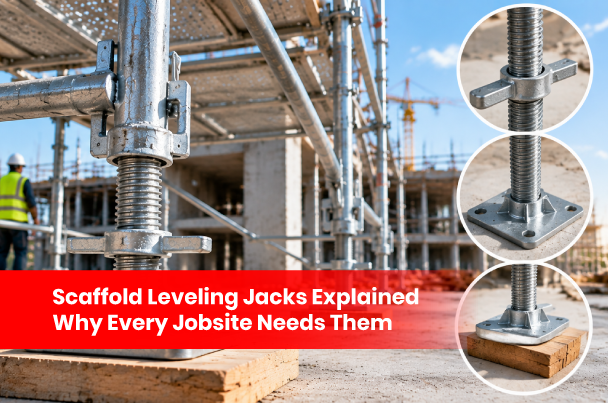
Before a scaffold can safely hold workers, tools, and materials, it needs a stable, properly leveled foundation. Real job sites don’t usually cooperate on that front. Slopes, uneven patches, random dips in elevation, they all get in the way of setting scaffold legs at a consistent height.
That’s the gap a scaffold leveling jack fills.
You’ll also hear it called an adjustable screw jack, a base jack, or just a leveling jack. Whatever the name, it does the same job: lets each scaffold leg get adjusted on its own so the whole structure comes out level. Get the right one and you end up with a sturdier, better-aligned setup, no cutting or modifying the scaffold required.
What Is a Scaffold Leveling Jack?
At its core, a scaffold leveling jack is just an adjustable support that sits under a scaffold leg. Most are built from three parts: a threaded stem, an adjustment nut, and a base plate.
Turning that nut raises or lowers the leg it’s attached to. Multiply that across every leg and you’ve got a scaffold that can compensate for an uneven site and still keep its working platform level.
It’s basically an adjustable foot for the scaffold. Rather than living with whatever slope the ground gives you, you dial in the height until everything lines up.
Why Are Scaffold Leveling Jacks Important?
There’s more to leveling than making a scaffold look neat from a distance. Get the adjustment right and you’re protecting the scaffold’s geometry and giving the whole structure something solid to stand on.
A few reasons crews reach for leveling jacks on almost every job:
1. They Help Compensate for Uneven Ground
No two job sites are identical. You’ll run into concrete slabs, compacted soil, sloped patches, low spots, sometimes all in the same fifty feet. A leveling jack handles that by letting each leg find its own height instead of forcing every leg to match a surface that was never flat to begin with.
2. They Help Maintain a Level Working Platform
Alignment isn’t optional for a scaffold platform.
Let one side sit even slightly higher than the other and workers feel it immediately, an uneven platform underfoot, plus knock-on effects to the scaffold’s overall geometry.
This is where adjustable screw jacks do their real work: fine height control at the base, dialed in until the platform sits where it needs to.
3. They Provide a Proper Base Support
A base plate spreads the load out, giving the scaffold a wider footprint on whatever surface it’s sitting on.
None of that means a jack can rescue bad ground, though. Soft or unstable soil is still soft or unstable soil. The surface underneath still has to be prepped properly and rated to carry the scaffold’s loads.
4. They Make Scaffold Setup More Flexible
Ground conditions change from project to project, sometimes from one side of a building to the other.
A fixed-height support just can’t flex the way a site with varying elevation demands. Adjustable jacks give crews room to adapt on the fly instead of fighting the ground.
Handy on jobs with uneven floors, shifting elevations, or a suitable incline to deal with.
How Does a Scaffold Leveling Jack Work?
Nothing complicated going on mechanically.
A threaded stem and an adjustment nut do most of the work. The scaffold leg or standard then sits on or connects into the jack, exactly how depends on which scaffold system you’re running.
In practice, it plays out like this:
- Position the jack on a suitable supporting surface.
- Connect the scaffold leg or standard to the jack.
- Check the elevation of the scaffold.
- Turn the adjustment nut to raise or lower the leg.
- Check the scaffold again to confirm proper level and alignment.
- Complete the setup according to the scaffold manufacturer’s instructions and applicable site requirements.
That threading is what makes the height adjustment controlled and repeatable, all without disturbing anything built up above it.
Types of Scaffold Leveling Jacks
Different jobs call for different jacks. Which one’s right comes down to the scaffold system in use, the ground you’re working with, how much adjustment you actually need, and what the jack’s meant to do.
Adjustable Screw Jacks
These are the standard pick for leveling scaffold systems, and for good reason.
A threaded adjustment mechanism does the work of changing height leg by leg.
They double as starting bases for compatible scaffold systems, and they’re especially useful once the ground starts changing elevation across a site.
Screw Jack With Base Plate
Weld a base plate onto an adjustable threaded stem and you get a screw jack with a fixed base plate.
That gives you a support point that’s ready to go straight out of the box, while each leg still gets leveled on its own.
Stem length, adjustment range, thread type, base plate size, all of it varies by model.
Check the specs before you buy. Don’t assume.
Swivel Jacks
Not every jack suits every surface.
Swivel jacks step in where the supporting surface is inclined or pitched. The swivel lets the base tilt with the angle instead of fighting it.
That makes them a fit for specialized scaffold work on surfaces that were never going to be level in the first place.
Socket Jacks
Socket jacks pair with compatible scaffold accessories and base setups.
Individual adjustment comes standard, and they show up often on rolling scaffold towers and similar compatible builds.
Compatibility is really the whole story here. Pair a socket jack only with components built to work alongside it.
Scaffold Leveling Jack vs. Post Screw Jack
Names for scaffold components shift depending on who you’re talking to, supplier, contractor, or scaffold system. Don’t read too much into a label.
A post screw jack, broadly speaking, is an adjustable threaded support used to raise, lower, or hold up a vertical member.
Depending on the application, you might hear the same kind of part called:
- Screw jacks
- Base jacks
- Leveling jacks
- Adjustable jacks
- Scaffold jacks
The name shouldn’t be what decides your purchase.
Before you pick a jack, confirm:
- Scaffold system compatibility
- Stem diameter
- Overall length
- Adjustment range
- Base plate dimensions
- Thread type
- Material and finish
- Required load capacity
- Manufacturer requirements
Mismatch the jack to the scaffold system and you’re setting yourself up for compatibility issues, or worse, performance problems down the line.
How to Choose the Right Adjustable Jack
Picking the right adjustable jack means actually knowing your scaffold and your site, not eyeballing it.
1. Check Scaffold Compatibility
Nail down the scaffold system first.
Frame scaffolding, RingLock, CupLock, each comes with its own component requirements.
Don’t assume a jack fits just because it looks like it should.
2. Measure the Required Adjustment
How much does the height actually vary across the install area? That’s the number you need.
Too little adjustment and you’re stuck. Too much length and the jack might not even suit the application.
Measure first, buy second.
3. Consider the Ground Conditions
Figure out exactly where this scaffold is landing.
Common conditions include:
- Flat concrete
- Uneven ground
- Changing elevations
- Inclined surfaces
- Pitched surfaces
Working on an incline? A compatible swivel jack usually outperforms a standard fixed base jack there.
4. Check the Base Plate
The base plate is what actually connects the jack to the ground beneath it.
Look at plate dimensions, thickness, connection points, and how well it matches the supporting arrangement you’ve got.
5. Check Material and Finish
Jobsite conditions aren’t gentle on scaffold jacks.
Solid steel construction matters, and so does a finish suited to wherever the jack’s actually going to live. Galvanized and electroplated finishes are the usual picks for extra corrosion resistance.
Common Mistakes to Avoid
Even the best leveling jack can’t undo a scaffold foundation that was never prepped right.
Here’s where people usually go wrong.
Using a Jack on Unstable Ground
A leveling jack was never meant to patch over soft, unstable, or poorly prepared ground. Whatever’s supporting the scaffold needs to actually be suitable for the loads it’ll carry.
Choosing the Wrong Jack Size
A jack can look right and still be the wrong one for your scaffold system. Stem diameter, overall length, adjustment range, base plate dimensions, check every one of them before buying.
Exceeding the Adjustment Range
Pushing a jack past its intended range isn’t a shortcut, it’s a risk.
Over-extend it and you change how the jack actually supports the scaffold, sometimes in ways that create safety problems nobody needed.
Stick to the manufacturer’s stated limits.
Mixing Incompatible Components
Just because two parts look like they fit doesn’t mean they should go together. The jack, the scaffold standard, the base plate, all of it needs to match the intended scaffold system, not just resemble it.
Ignoring Manufacturer Instructions
Manufacturer instructions, project requirements, applicable regulations, competent-person inspections, scaffold installation needs to follow all of it.
A leveling jack is one piece. Not the whole system.
When Should You Use a Scaffold Leveling Jack?
A scaffold leveling jack tends to be the right call when:
- The supporting surface is uneven.
- Individual scaffold legs require height adjustment.
- A level working platform needs to be established.
- The scaffold is being installed over changing elevations.
- The project requires adjustable base supports.
- The scaffold is being installed on a suitable inclined surface with a compatible swivel jack.
Let the scaffold design and the actual site conditions choose the jack type, not whatever’s easiest to grab.
Benefits of Using the Right Scaffold Leveling Jack
Get the jack right and scaffold setup gets noticeably more controlled, more adaptable too.
The benefits break down like this:
Better Leveling
Each leg adjusts on its own to close the gap left by uneven ground, so the structure as a whole sits the way it should.
Greater Setup Flexibility
Adjustable components mean crews aren’t limited to sites with perfectly consistent ground. A much wider range of conditions becomes workable.
Improved Alignment
Small, fine adjustments add up to the scaffold geometry the job actually calls for, plus a platform that stays level.
Better Component Compatibility
Pick the right jack and it works with the scaffold system the way it’s supposed to, instead of becoming another thing to troubleshoot.
Easier Height Adjustment
The jack mechanism handles height changes directly. Nobody has to go modifying the scaffold structure itself just to get things level.
Final Takeaway
A scaffold is never more reliable than the foundation it’s standing on. Ground levels shift from spot to spot, and a scaffold leveling jack is what closes that gap and gets the scaffold base properly aligned.
Standard adjustable screw jacks, swivel jacks, socket jacks, whichever one’s correct depends entirely on the scaffold system and the site in front of you, not preference.
Before settling on a jack, run through compatibility, adjustment range, stem dimensions, base plate, and what the supporting surface actually requires.
Get that adjustable jack choice right and scaffold installation becomes noticeably more adaptable, with alignment and leveling holding steady for the rest of the project.
FAQs About Scaffold Leveling Jacks
What is a scaffold leveling jack?
A scaffold leveling jack is an adjustable support that sits at the base of a scaffold leg. It lets that leg go up or down to compensate for uneven ground.
Are scaffold leveling jacks and adjustable screw jacks the same?
Usually, yes, though the terminology isn’t perfectly consistent across suppliers. Adjustable screw jacks use a threaded mechanism to adjust height right at the scaffold base.
Can a scaffold leveling jack be used on uneven ground?
It can help on suitable uneven surfaces, but the ground underneath still needs to be properly prepared and capable of supporting the load. A leveling jack isn’t a substitute for stable ground.
What is a post screw jack used for?
A post screw jack is an adjustable threaded support that gives controlled height adjustment to compatible vertical support components. Confirm its intended application and compatibility before putting one to use.
How do I choose the right adjustable jack?
Start with your scaffold system, then work through the required adjustment range, stem diameter, base plate dimensions, ground conditions, and manufacturer requirements. Whatever you pick has to be compatible with the scaffold components already in play.
Do all scaffold jacks work with RingLock and CupLock?
No. It comes down to the jack’s dimensions and the scaffold system involved. Check the product specifications before buying or installing anything.