


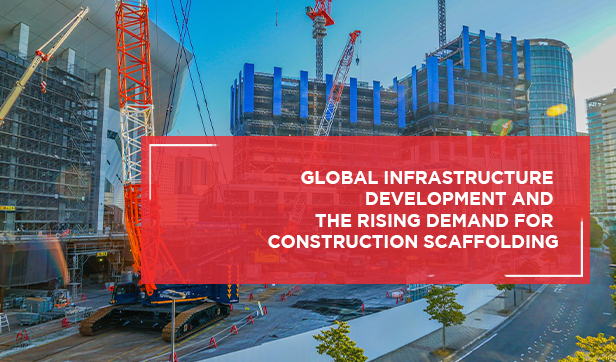
Urbanization, smart cities, and big government investments are all speeding up the growth of infrastructure around the world at an unprecedented rate. Construction work is growing in both developed and emerging economies. It includes everything from highways and bridges to high-rise buildings and energy projects.
The worldwide scaffolding market is expected to be worth $59.81 billion in 2026 and $79.6 billion by 2034. This constant rise is due to the need for infrastructure. (Fortune Business Insights)
This rise clearly indicates how important scaffolding has become for making building safe and efficient all across the world.
What is driving global infrastructure development?
Rapid urbanization, more government spending, industrial growth, and the introduction of smart city programs are all driving the growth of global infrastructure. These things are making building in high demand, which means that scaffolding systems are needed more than ever on all kinds of projects.
- Transportation: roads, bridges, and airports
- Energy: oil and gas, and renewable sources
- Urban: homes, smart cities
What is driving infrastructure growth in 2026?
1. Rapid Urbanization
As more people move to cities, the need for housing and infrastructure is growing over the world.
The need for scaffolding is growing because of more construction and high-rise buildings in cities around the world. (Yahoo Finance)
2. Government Infrastructure Investment
A large amount of money is being invested by governments in upgrading and developing infrastructure.
The scaffolding market based on construction is expected to grow at a CAGR of more than 7.1% from 2024 to 2029. (Technavio)
3. Industrial & Energy Expansion
Heavy construction support systems like scaffolding are needed for factories, logistics hubs, and energy plants.
Why does infrastructure growth increase scaffolding demand?
Scaffolding is necessary for infrastructure projects because they need safe access to heights, structural support, and quick building methods.
The scaffolding market is expected to rise from $53.5 billion in 2024 to more than $75 billion by 2031. This is because more buildings are being built. (Cognitive Market Research)
Infrastructure projects alone make up more than 41% of the world’s overall demand for scaffolding, making it the biggest application segment. (Market.us)
Where is scaffolding used in infrastructure projects?
- Roads and bridges
- Buildings that are tall
- Factories
- Projects for oil and energy
Which regions are driving scaffolding demand globally?
Asia-Pacific (Dominant Market)
Asia-Pacific has more than 40% of the world’s market share, thanks to rising urbanization. The area was worth USD 23.38 billion in 2025 and is expected to be worth USD 24.56 billion in 2026. This growth is due to increasing industrialization, huge infrastructure projects, and large government investments in public works and transportation infrastructure. China is the biggest player in the regional market, with a value of USD 11.27 billion by 2026. This is thanks to its large construction industry and government-led projects like the Belt and Road Initiative. India and Japan follow with projected market values of USD 6.35 billion and USD 2.58 billion, respectively, by 2026. (Fortune Business Insights)
Middle East (Mega Infrastructure)
Big development and government-backed initiatives in the area are driving growth. With a market size of USD 1,070.97 million in 2024, the Middle East and Africa made up around 2% of the global scaffolding market income. This shows how important the region is becoming in global construction. From 2024 to 2031, this market is expected to grow at a CAGR of 4.7%. This is because there are a lot of big infrastructure projects funded by the government and investments in big building projects across the region. (Cognitive Market Research)
Europe & USA
- Fixing up the infrastructure
- Rebuilding cities
The main things that drive demand are more refurbishment projects and following safety rules. The Global Automatic Scaffolding Market is expected to grow from USD 8.59 billion in 2025 to USD 12.01 billion by 2031, with a CAGR of 5.74%. The US and Europe, which have a lot of renovations going on, are major contributors to this growth. This is because there is a growing need for high-rise urban redevelopment and stricter safety rules at work. The move toward lightweight modular systems and robotic integration is making assembly more efficient and shortening project timelines, which is helping this growth. At the same time, U.S. construction spending is at a seasonally adjusted annual rate of USD 2.15 trillion, showing that the region is still committed to fixing and upgrading its infrastructure. (Yahoo Finance)
What are the latest trends in scaffolding?
1. Modular Scaffolding Systems
About 52% of manufacturers have switched to modular solutions, which have made things about 36% safer. The larger formwork and scaffolding market is also seeing this growth. It was worth USD 59,276.86 million in 2026 and is predicted to grow at a rate of 6.35% per year to reach USD 103,169.81 million by 2035. In 2024, 48% of all new product introductions will be modular and safety-enhanced designs. (Industry Research)
2. Lightweight Materials (Aluminum Growth)
About 44% of businesses are switching to lighter materials, which makes installation more cheaper. Aluminum formwork has become quite popular in regions that are growing quickly. For example, the use of aluminum formwork has gone up by 27% in India’s metro-rail extension projects. ULMA Construction’s aluminum modular systems alone make up about 38% of all lightweight formwork solutions on the global market. (Industry Research)
3. Digital & Smart Construction
- BMI Integration
- Monitoring safety with the Internet of Things
Almost 41% of providers are adding digital tools to their scaffolding systems. The effect is most clear in Europe, where more than 68% of big projects now use digitalized scaffolding planning tools. At least 240 German infrastructure projects have used digital formwork modeling, which has cut labor hours by about 14%. BIM-compatible solutions have made the process of going from design to execution even more efficient, by 29%. (Industry Research)
4. Rental & Reusable Models
Rental scaffolding systems meet about 57% of short-term building needs. This rental-driven model is getting a lot of support from institutions. About 38% of market players have added more rental services to their portfolios in 2024, and rental use in urban Europe is already over 70%. This shows that mature construction markets are moving toward flexible, cost-effective ways to buy scaffolding. (Industry Research)
How does scaffolding support large infrastructure projects?
- Lets people operate safely at height
- Increases output
- Lessens wait times
Scaffolding is an important part of building, maintaining, and fixing things. (Technavio Newsroom)
What challenges does the scaffolding industry face?
- Not enough workers
- Safety risks
- The cost changes
A lack of skilled workers is still a major barrier to progress in the global economy. (Yahoo Finance)
What is the future of the scaffolding industry?
The scaffolding sector is likely to keep growing as more money is put into infrastructure and technology keeps becoming better.
The market is expected to increase at a rate of about 5.9% per year and reach $106 billion by 2035. (Market Research Future)
Some projections say that the market could potentially reach $100 billion before 2030, which shows that there is a lot of long-term demand. (Bonafide Research).
Infrastructure-led building will continue to be the key reason for this increase.
Why are contractors shifting to modern scaffolding systems?
- Installation is faster
- More safety
- Cost-effectiveness
- Reuse
CONCLUSION (CTA)
The construction of infrastructure around the world is not slowing down. Scaffolding will continue to be very important for safe and efficient building as more money is put into smart cities, transportation, and energy.
In the changing world of construction, businesses who use modern, modular, and technology-driven scaffolding systems will have an edge over their competitors.
FAQs
What is scaffolding in infrastructure construction?
During the construction, maintenance, or repair of structures and infrastructure, scaffolding is a temporary framework that supports workers and supplies.
Why is scaffolding important in infrastructure projects?
It makes sure that everyone is safe, gives workers access to high places, and speeds up big construction projects.
How big is the global scaffolding market in 2026?
The scaffolding industry will be worth around $59.81 billion in 2026, and it will keep growing because of the need for more infrastructure. (Fortune Business Insights)
Which region has the highest scaffolding demand?
Asia-Pacific has more than 40% of the worldwide market share, thanks to rising urbanization and infrastructure initiatives. (Fortune Business Insights)
What are the latest trends in scaffolding industry?
Modular systems, lightweight materials, digital integration, and rental-based models are some of the most important trends in the sector.
What is the future of scaffolding in construction?
Smart cities and the growth of infrastructure are predicted to push the market beyond $100 billion by 2030–2035. (Market Research Future)
Comments are closed